Publications from 2022
Graphs in nature.
D. Eppstein.
Invited talk at Symposium on Geometry Processing, Milan, Italy, July 2019.
Invited talk at Algorithms and Data Structures Symposium, Edmonton, Canada, August 2019.
Invited talk at International Colloquium on Graph Theory and
Combinatorics, Montpellier, France, July 2022.
I survey results on characterizing the graphs formed on planar surfaces according to several natural processes: motorcycle graphs, Gilbert tessellations, and the contact graphs of line segments from needle-like crystal growth and crack formation; the graphs of planar soap bubble foams; and graphs representing the fold patterns of crumpled paper.
Ununfoldable polyhedra with 6 vertices or 6 faces.
H. A. Akitaya,
E. Demaine,
D. Eppstein,
T. Tachi, and
R. Uehara.
22nd Japan Conference on Discrete and Computational Geometry, Graphs,
and Games (JCDCG3), Tokyo, Japan, 2019, pp. 27–28.
Comp. Geom. Theory & Applications 103: 101857, 2022, doi:10.1016/j.comgeo.2021.101857.
We find a (nonconvex, but topologically equivalent to convex) polyhedron with seven vertices and six faces that cannot be unfolded to a flat polygon by cutting along its edges, and another with six vertices and seven faces. Both the number of vertices and the number of faces are the minimum possible. The JCDCG3 version used the title "Minimal ununfoldable polyhedron".
This is the second in a sequence of papers on ununfoldable polyhedra; see also "Ununfoldable polyhedra" and "Acutely triangulated, stacked, and very ununfoldable polyhedra".
Some polycubes have no edge-unzipping.
E. Demaine,
M. Demaine,
D. Eppstein, and
J. O'Rourke.
arXiv:1907.08433.
Proc. 32nd Canadian Conference on Computational Geometry, 2020, pp. 101–105.
Geombinatorics 31 (3): 101–109, 2022.
We find polycubes that cannot be cut along a simple path through their vertices and edges and unfolded to form a flat polygon in the plane.
(CCCG'20 talk video by O'Rourke – Blog post: A zipless polycube)
On the treewidth of Hanoi graphs.
D. Eppstein,
D. Frishberg, and
W. Maxwell.
arXiv:2005.00179.
Proc. 10th Int. Conf. Fun with Algorithms (FUN 2021).
Leibniz International
Proceedings in Informatics (LIPIcs) 157, 2020, pp. 13:1–13:21, doi:10.4230/LIPIcs.FUN.2021.13.
Theor. Comput. Sci. 906: 1–17, 2022, doi:10.1016/j.tcs.2021.12.014.
The \(n\)-disc \(p\)-peg Hanoi graphs have treewidth within a polynomial factor of \(n^{p-1}\). In a follow-up paper, "On the expansion of Hanoi graphs", we eliminated the polynomial factor.
Stack-number is not bounded by queue-number.
V. Dujmović,
D. Eppstein,
R. Robert Hickingbotham,
P. Morin, and
D. R. Wood.
arXiv:2011.04195.
Combinatorica 42: 151–164, 2022, doi:10.1007/s00493-021-4585-7.
Stack number is also known as page number or book thickness; it is the minimum number of stacks needed so that you can process the vertices of a graph in some sequence, pushing each edge onto one of the stacks when you process its first endpoint and popping it from the same stack when you process its second endpoint. Queue number is defined in the same way using queues instead of stacks. We show that the strong products of triangular grids and high-degree stars have bounded queue number but unbounded stack number. This result disproves the Blankenship–Oporowski conjecture, according to which subdividing edges of a graph a constant number of times cannot decrease its stack number from non-constant to constant, because subdivisions of the same products also have bounded stack number. It also confirms a conjecture of Bonnet et al on the existence of graphs with bounded sparse twin-width and unbounded stack number.
Geometric dominating sets – A minimum version of the no-three-in-line problem.
O. Aichholzer,
D. Eppstein, and
E.-M. Hainzl.
37th European Workshop on Computational Geometry (EuroCG 2021), pp. 17:1–17:7.
arXiv:2203.13170.
Comp. Geom. Theory & Applications 108: 101913, 2023 (special issue for EuroCG), doi:10.1016/j.comgeo.2022.101913.
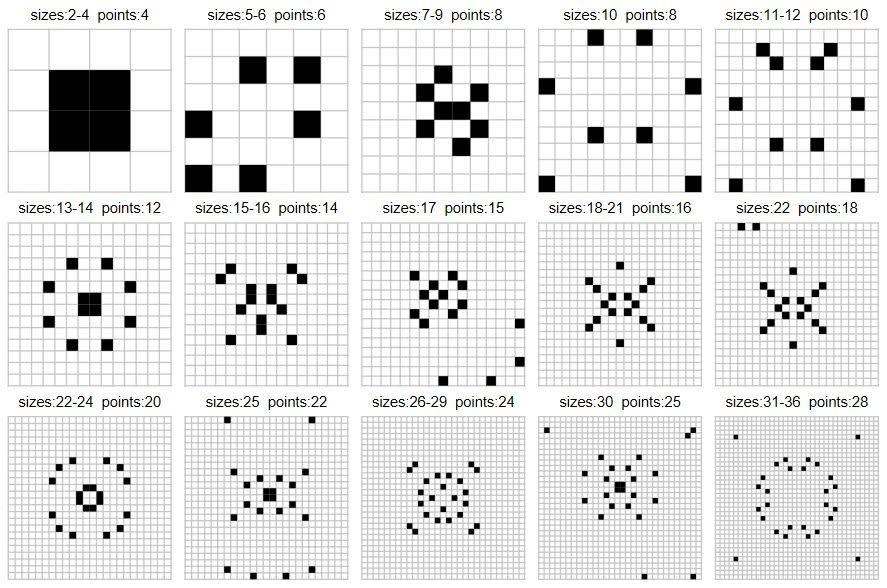
We study how few points can be placed in a grid so that all remaining grid points are collinear with two of the placed points. The illustration below was sent to me by Ed Pegg.
(Blog post: How good is greed for the no-three-in-line problem?)
Distributed construction of lightweight spanners for unit ball graphs.
D. Eppstein and
H. Khodabandeh.
arXiv:2106.15234.
Brief
announcement, 34th ACM Symposium on Parallelism in Algorithms and
Architectures, 2022, pp. 57–59, doi:10.1145/3490148.3538553.
Proc. 36th International Symposium on Distributed Computing (DISC
2022).
Leibniz International
Proceedings in Informatics (LIPIcs) 246, 2022,
pp. 21:1–21:23, doi:10.4230/LIPIcs.DISC.2022.21.
Metric spaces of bounded doubling dimension have spanners with bounded degree, weight a bounded multiple of the minimum spanning tree weight, and dilation arbitrarily close to one, that can be found efficiently by a distributed algorithm.
(Blog post: Spanners for unit ball graphs in doubling spaces)
Finding relevant points for nearest-neighbor classification.
D. Eppstein.
arXiv:2110.06163.
Proc. SIAM Symp. Simplicity in Algorithms, 2022, pp. 68–78, doi:10.1137/1.9781611977066.6 (best paper award).
The nearest-neighbor classification problem considered here takes as input a training set of points in a Euclidean space, each with a classification from some finite set of classes or colors, and then uses that input to predict the classification of new points as being equal to that of the nearest neighbor in the input training set. A training point is irrelevant when removing it from the training set would produce the same predicted classification for all possible new points that might be queried. We describe how to find all of the relevant points, in polynomial time, using a simple algorithm whose only components are construction of a minimum spanning tree of the training set and the computation of extreme points (convex hull vertices) of geometrically transformed subsets of points. For any constant dimension, with \(k\) relevant points resulting from a training set of \(n\) points, this method can be made to take time \(O(n^2+k^2n)\), using only simple algorithms for the minimum spanning tree and extreme point subroutines. For small dimensions, somewhat better but more complicated bounds are possible.
The complexity of iterated reversible computation.
D. Eppstein.
arXiv:2112.11607.
Invited talk at 15th Latin American Theoretical Informatics Symposium,
Guanajuato, Mexico, November 2022.
TheoretiCS 2: A10:1–A10:41, 2023, doi:10.46298/theoretics.23.10.
We study a class of problems involving computing a value \(f^{(n)}(x)\), the \(n\)th iterate of a function \(f\), for polynomial time bijections. We prove that these problems are complete for \(\mathsf{P}^{\mathsf{PSPACE}}\), and include hard problems in circuit complexity, graph algorithms, the simulation of one- and two-dimensional automata, and dynamical systems. We also provide a polynomial time algorithm for the special case where the bijection is an interval exchange transformation.
(Blog posts: Raytracing diamonds and Fast iterated exchange transformations via normal curves)
Three-dimensional graph products with unbounded stack-number.
D. Eppstein,
R. Robert Hickingbotham,
L. Merker,
S. Norin,
M. T. Seweryn, and
D. R. Wood.
arXiv:2202.05327.
Discrete Comput. Geom. 71: 1210–1237, 2024, doi:10.1007/s00454-022-00478-6.
The strong product of any three graphs of non-constant size has unbounded book thickness. In the case of strong products of three paths, and more generally of triangulations of \(n\times n\times n\) grid graphs obtained by adding a diagonal to each square of the grid, the book thickness is \(\Theta(n^{1/3})\). This is the first explicit example of a graph family with bounded maximum degree and unbounded book thickness.
Orthogonal dissection into few rectangles.
D. Eppstein.
arXiv:2206.10675.
34th Canadian Conference on Computational Geometry, 2022, pp. 143–150.
Discrete Comput. Geom. 73 (1): 129–148, 2025, doi:10.1007/s00454-023-00614-w.
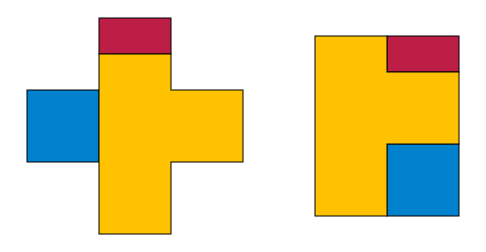
The rank of the Dehn invariant of an orthogonal polygon equals the minimum number of rectangles into which it can be transformed by axis-parallel cuts, translation, and gluing. This allows the minimum number of rectangles to be calculated in polynomial time.
(CCCG'22 dissection slides – Blog posts: Dissection into rectangles and tensor rank and Dehn rank revisited))
Reflections in an octagonal mirror maze.
D. Eppstein.
arXiv:2206.11413.
34th Canadian Conference on Computational Geometry, 2022, pp. 129–134.
For two-dimensional scenes consisting of mirrors and opaque walls that are either axis-parallel or with slope ±1, with integer endpoints, it is possible to determine the eventual destination of rational light rays in time polynomial in the description complexity of the scene, even though the number of reflections before a ray reaches this destination may be exponential. The solution involves transforming the problem into one involving interval exchange transformations and from there into another problem involving normal curves on topological surfaces.
(CCCG'22 reflection slides – Blog post: Reflections in an octagonal mirror maze)
Locked and unlocked smooth embeddings of surfaces.
D. Eppstein.
arXiv:2206.12989.
34th Canadian Conference on Computational Geometry, 2022, pp. 135–142.
Computing in Geometry and Topology 2 (2): 5.1–5.20, 2023, doi:10.57717/cgt.v2i2.28.
If a subset of the plane has a continuous shrinking motion of itself, then every smooth isometric embedding of that subset into 3d can be smoothly flattened. However, there exist subsets of the plane with holes, for which some smooth embeddings that are topologically equivalent to a flat embedding cannot be smoothly flattened.
(CCCG'22 surface-unfolding slides – Blog post: The motion of bend lines on smooth surfaces)
Improved mixing for the convex polygon triangulation flip walk.
D. Eppstein and
D. Frishberg.
arXiv:2207.09972.
Proc. 50th EATCS International Colloquium on Automata, Languages, and Programming (ICALP 2023).
Leibniz International
Proceedings in Informatics (LIPIcs) 261, 2023, pp. 56:1–56:17, doi:10.4230/LIPIcs.ICALP.2023.56.
The associahedron is a polytope whose vertices represent the triangulations of a convex polygon, and whose edges represent flips connecting one triangulation to another. We show that a random walk on the edges of this polytope rapidly converges to the uniform distribution on triangulations. However, we also show that the associahedron does not have constant expansion.
Geodesic paths passing through all faces on a polyhedron.
E. Demaine,
M. Demaine,
D. Eppstein,
H. Ito,
Y. Katayama,
W. Maruyama, and
Y. Uno.
24th Japan Conference on Discrete and Computational Geometry, Graphs, and Games, September 9–11, 2022.
Springer, Lecture
Notes in Comp. Sci. 14364 (2026), pp. 184–209, doi:10.1007/978-3-032-00281-5_12.
Which convex polyhedra have the property that there exist two points on the surface of the polyhedron whose shortest path passes through all of the faces of the polyhedron? The answer is yes for the tetrahedron, and for certain prisms, but no for all other regular polyhedra.
Product structure extension of the Alon–Seymour–Thomas theorem.
M. Distel,
V. Dujmović,
D. Eppstein,
R. Robert Hickingbotham,
G. Joret,
P. Micek,
P. Morin,
M. T. Seweryn, and
D. R. Wood.
arXiv:2212.08739.
SIAM J. Discrete
Math. 38 (3): 2095–2107, 2024, doi:10.1137/23M1591773.
The graphs in any nontrivial minor-closed graph family can be represented as strong products of a graph of treewidth 4 with a clique of size \(O(\sqrt{n})\). For planar graphs and \(K_{3,t}\)-minor-free graphs, the treewidth can be reduced to 2. An earlier version of the preprint with only the first part of these results used a different title, "Graphs excluding a fixed minor are \(O(\sqrt{n})\)-complete-blowups of a treewidth 4 graph".