Dissection
This page involves problems of cutting a region (such as a polygon into the plane) into pieces (possibly putting them together to form a different polygon). Related topics include tiling (in which the whole plane is cut into pieces) and triangulation (in which a region is cut into triangles or higher-dimensional simplices).
Henry Baker's hypertext version of HAKMEM includes a dissection of square and hexagon, depicted below.

Cube Dissection. How many smaller cubes can one divide a cube into? From Eric Weisstein's treasure trove of mathematics.
Dissection challenges. Joshua Bao asks for some dissections of squares into other figures.
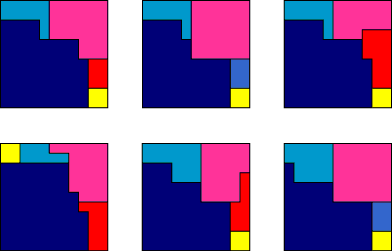
Dissection and dissection tiling. This page describes problems of partitioning polygons into pieces that can be rearranged to tile the plane. (With references to publications on dissection.)
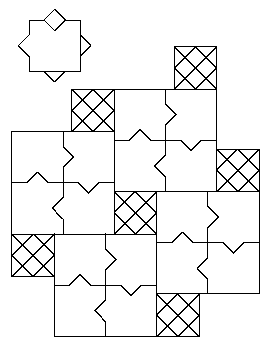
Dissection problem-of-the-month from the Geometry Forum. Cut squares and equilateral triangles into pieces and rearrange them to form each other or smaller copies of themselves.
A dissection puzzle. T. Sillke asks for dissections of two heptominoes into squares, and of a square into similar triangles.
Dissections. From Eric Weisstein's treasure trove of mathematics.
Dissections de polygones, réguliers ou non réguliers. Various polygon dissections, animated in CabriJava.
Dissections: Plane & Fancy, Greg Frederickson's dissection book. Greg also has a list of more links to geometric dissections on the web.
The equivalence of two face-centered icosahedral tilings with respect to local derivability, J. Phys. A26 (1993) 1455. J. Roth dissects an aperiodic three-dimensional tiling involving zonohedra into another tiling involving tetrahedra and vice versa.
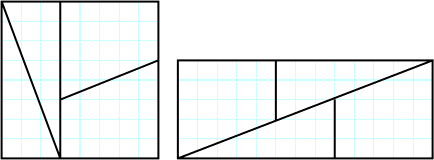
Fake dissection. An 8x8 (64 unit) square is cut into pieces which (seemingly) can be rearranged to form a 5x13 (65 unit) rectangle. Where did the extra unit come from? Jim Propp asks about possible three-dimensional generalizations. Greg Frederickson supplies one. See also Alexander Bogomolny's dissection of a 9x11 rectangle into a 10x10 square and Fibonacci bamboozlement applet.
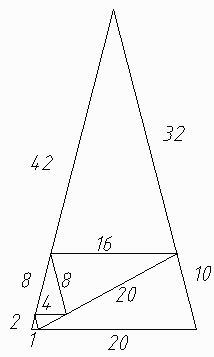
Erich Friedman's dissection puzzle. Partition a 21x42x42 isosceles triangles into six smaller triangles, all similar to the original but with no two equal sizes. (The link is to a drawing of the solution.)
Geometric Dissections by Gavin Theobald.
Geometry corner with Martin Gardner. He describes some problems of cutting polygons into similar and congruent parts. From the MAT 007 I News.
Hilbert's 3rd Problem and Dehn Invariants. How to tell whether two polyhedra can be dissected into each other. See also Walter Neumann's paper connecting these ideas with problems of classifying manifolds.
Hinged dissections of polyominoes.

Hinged kite mirror dissection. General techniques for cutting any polygon into pieces that can be unfolded and refolded to form the polygon's mirror image.
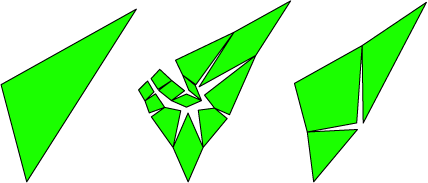
Isosceles pairs. Stan Wagon asks which triangles can be dissected into two isosceles triangles.
Magical transformations. Wil Laan animates several dissections and almost-dissections.
Mutations and knots. Connections between knot theory and dissection of hyperbolic polyhedra.
No cubed cube. David Moews offers a cute proof that no cube can be divided into smaller cubes, all different.
The Partridge Puzzle. Dissect an (n choose 2)x(n choose 2) square into 1 1x1 square, 2 2x2 squares, etc. The 30-60-90 triangle version of the puzzle is also interesting
Pi squared by six rectangle dissected into unequal integer squares (or an approximation thereof) by Clive Tooth.
Plates and crowns. Erich Friedman investigates the convex polygons that can be dissected into certain pentagons and heptagons having all angles right or 135 degrees.
Polyhedral nets and dissection. David Paterson outlines an algorithm to search for minimal dissections.
PolyMultiForms. L. Zucca uses pinwheel tilers to dissect an illustration of the Pythagorean theorem into few congruent triangles.
Polyominoes, figures formed from subsets of the square lattice tiling of the plane. Interesting problems associated with these shapes include finding all of them, determining which ones tile the plane, and dissecting rectangles or other shapes into sets of them. Also includes related material on polyiamonds, polyhexes, and animals.
Proteon's Puzzle Notes Wen-Shan Kao covers cubes with polyominos and polysticks, packs worms into boxes, and studies giant tangram like puzzles.
The Puzzling World of Polyhedral Dissections. Stewart T. Coffin's classic book on geometric puzzles, now available in full text on the internet!
Pythagorean theorem by dissection, Pythagorean dissection part II, and Pythagorean dissection part III, Java Applets by A. Bogomolny.
Pythagorean tilings. William Heierman asks about dissections of rectangles into dissimilar integer-sided right triangles.
Rational square. David Turner shows that a rectangle can only be dissected into finitely many squares if its sides are in a rational proportion.
75-75-30 triangle dissection. This isosceles triangle has the same area as a square with side length equal to half the triangle's long side. Ed Pegg asks for a nice dissection from one to the other.
Similar division. Mineyuki Uyematsu, Michael Reid, and Ed Pegg ask for divisions of given shapes into pieces, where all pieces must be similar to each other.
A small puzzle. Joe Fields asks whether a certain decomposition into L-shaped polyominoes provides a universal solution to dissections of pythagorean triples of squares.
Solution of Conway-Radin-Sadun problem. Dissections of combinations of regular dodecahedra, regular icosahedra, and related polyhedra into rhombs that tile space. By Dehn's solution to Hilbert's third problem this is impossible for individual dodecahedra and icosahedra, but Conway, Radin, and Sadun showed that certain combinations could work. Now Izidor Hafner shows how.
Squared squares and squared rectangles, thorough catalog by Stuart Anderson. Erich Friedman discusses several related problems on squared squares: if one divides a square into k smaller squares, how big can one make the smallest square? How small can one make the biggest square? How few copies of the same size square can one use? See also Robert Harley's four-colored squared square, Mathworld's perfect square dissection page, a Geometry Forum problem of the week on squared squares, Keith Burnett's perfect square dissection page, and Bob Newman's squared square drawing.
Stomachion, a tangram-like shape-forming game based on a dissection of the square and studied by Archimedes.
Straighten these curves. This problem from Stan Wagon's PotW archive asks for a dissection of a circle minus three lunes into a rectangle. The ancient Greeks performed similar constructions for certain lunules as part of an attempt to square the circle.
Three cubes to one. Calydon asks whether nine pieces is optimal for this dissection problem.
The tiling puzzle games of OOG. Windows and Java software for tangrams, polyominoes, and polyhexes.
Tiling a rectangle with the fewest squares. R. Kenyon shows that any dissection of a p*q rectangle into squares (where p and q are integers in lowest terms) must use at least log p pieces.
Tiling the unit square with rectangles. Erich Friedman shows that the 5/6 by 5/6 square can always be tiled with 1/(k+1) by 1/(k+1) squares. Will all the 1/k by 1/(k+1) rectangles, for k>0, fit together in a unit square? Note that the sum of the rectangle areas is 1. Marc Paulhus can fit them into a square of side 1.000000001: "An algorithm for packing squares", J. Comb. Th. A 82 (1998) 147-157, MR1620857.
A tour of Archimedes' stomachion. Fan Chung and Ron Graham investigate the number of different square solutions of this dissection puzzle.
Triangle to a square. David MacMillan asks geometry.puzzles about this dissection problem.
Turkey stuffing. A cube dissection puzzle from IBM research.
Frank Zubek's Elusive Cube. Magnetic tetrahedra connect to form dissections of cubes and many other shapes.