Exploring The World With a Geiger Counter
So my wife recently got me a Geiger counter, one of those clicky devices that tells the main character of a movie they're about to have a bad time, so that I can be a better nerd and explore the less than visible world around me... And so that I would have something to do when she drags me along to visit antique shops. The great part about this is that I'm already quite familiar with the field of nuclear physics (see my AS in physics), so the knowledge fell right into place with a few reminders. And that's what I plan to do here: explain enough that anyone could have an idea of how nuclear radiation works and then share some of the samples I've found in the wild.
The Science
I personally see nuclear physics as one of the last "just for fun" subjects that someone can study. That is, while it is fairly complex and gets into the realm of particle physics, the math required to understand its concepts is still quite low, and definitely more reasonable to understand than something like relativity or quantum. That said, we've had entire wars over the dangers of nuclear physics and, given the wrong subject, it can be deadly dangerous. So, I'll give the friendly introduction here. If you're a little unnerved reading this, just remember that (at least in the U.S.) radioactive material is highly regulated. Studying the world around us can only show us what is already there, and knowing about it can only help keep us safe in times of danger. Obviously if you or I find something highly radioactive, let's not be stupid and run away from it like normal people.
Atoms and Elements
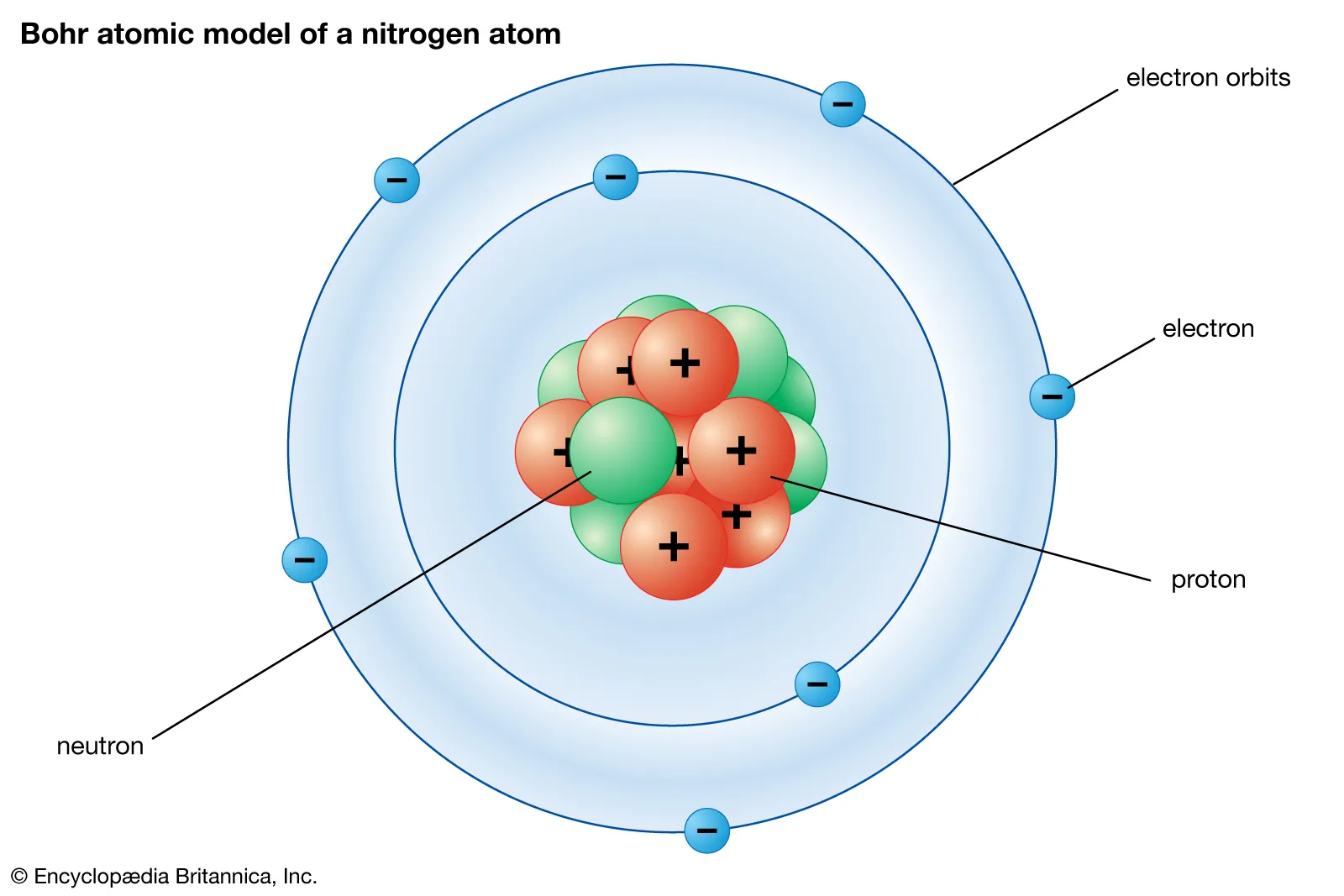 Credit: Encyclopædia Britannica, Inc.
Atoms are what make up literally all physical things around us. Think of them like the smallest unit of "thing," a single Iron or single Helium. Each
atom is made up of three types of particles: protons, neutrons, and electrons. The protons and neutrons stick together and form the nucleus of the atom,
while the electrons are like your little brother that can't stay still and whizz around it. You should know that protons are positively charged, electrons
are negatively charged, and neutrons have no charge (Yes, that's electrical, like the outlet in your wall). The number of protons in the nucleus determines
what element the atom is. The nucleus is held together by something called "nuclear force," which all you need to know is pretty strong at this size, and
the electrons are held in orbit through magnetic forces. Typically, atoms are most happy when they have the same number of protons and electrons, but the
number of electrons can vary. This gives the atom an electric charge, typically either +1 or -1 electron's-worth of charge. A charged atom is called an ion.
See the image. Yes, that model is outdated by a few decades. No, I don't care. No, we aren't getting into the quantum required to motivate the more recent model.
Credit: Encyclopædia Britannica, Inc.
Atoms are what make up literally all physical things around us. Think of them like the smallest unit of "thing," a single Iron or single Helium. Each
atom is made up of three types of particles: protons, neutrons, and electrons. The protons and neutrons stick together and form the nucleus of the atom,
while the electrons are like your little brother that can't stay still and whizz around it. You should know that protons are positively charged, electrons
are negatively charged, and neutrons have no charge (Yes, that's electrical, like the outlet in your wall). The number of protons in the nucleus determines
what element the atom is. The nucleus is held together by something called "nuclear force," which all you need to know is pretty strong at this size, and
the electrons are held in orbit through magnetic forces. Typically, atoms are most happy when they have the same number of protons and electrons, but the
number of electrons can vary. This gives the atom an electric charge, typically either +1 or -1 electron's-worth of charge. A charged atom is called an ion.
See the image. Yes, that model is outdated by a few decades. No, I don't care. No, we aren't getting into the quantum required to motivate the more recent model.
Isotopes
The number of protons in a nucleus defines the element, the number of electrons defines the ion, and that leaves the neutrons just hanging around. Typically, each element has a number of neutrons in its nucleus that makes it most happy, but neutrons are just free-loading charge-free particles. Really you can jam as many as you want in there (if only for a couple nanoseconds). An element with a given number of neutrons is called an isotope. It has an isotope number equal to the number of protons plus neutrons in the nucleus. So, the isotope Hydrogen-3 has a single proton (making it Hydrogen), and 2 neutrons, for an isotope number of 3. It's also called Tritium. Honestly, I forget if there's a good reason for including the number of protons in the isotope number. The way science works it may just be a strange habit that stuck.
Radiation
Radiation is a term that generically refers to "energy given off by something." Sound is radiation, heat is radiation, certain particles are radiation, and even light (electromagnetic radiation) is radiation. In nuclear physics, nuclear radiation refers to particles (or waves), given off by certain elements (or isotopes thereof) during nuclear decay.
Nuclear Decay
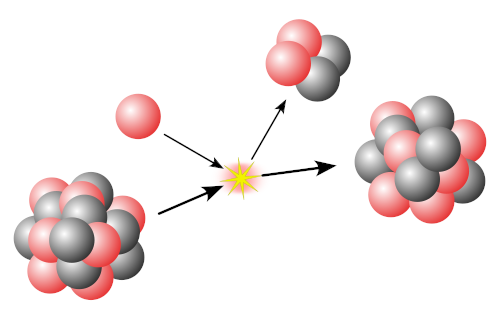 Credit: Kjerish (Wikipedia)
The term "nuclear decay" is actually pretty self explanatory. It is an event during which the nucleus of an atom decays. The atom becomes multiple atoms of
elements with fewer protons. Nuclear decay happens because the nucleus of an atom is unstable and can't hold itself together through the nuclear force
anymore, typically because it is too big, which can be caused by having too many neutrons. The decay then usually makes the atom more stable as a result of
shedding some energy/radiation. To my understanding, the actual decay, or breaking apart of the nucleus, is described as a quantum leap of part of the
nucleus away from the rest of itself. Without getting too much into it, quantum leaps are defined by probability waves, which means nuclear decay is about
as close to true randomness as we can get in nature (which is really cool!). During nuclear decay, certain particles are given off which we observe as the
commonly known "radiation." There are several types of potential particles including alpha, beta, gamma, nucleons, x-rays, etc., but we will focus on the
most common alpha (α), beta (β), and gamma (γ) particles. As is often the case, check out
Wikipedia for a good introduction to all of this.
Credit: Kjerish (Wikipedia)
The term "nuclear decay" is actually pretty self explanatory. It is an event during which the nucleus of an atom decays. The atom becomes multiple atoms of
elements with fewer protons. Nuclear decay happens because the nucleus of an atom is unstable and can't hold itself together through the nuclear force
anymore, typically because it is too big, which can be caused by having too many neutrons. The decay then usually makes the atom more stable as a result of
shedding some energy/radiation. To my understanding, the actual decay, or breaking apart of the nucleus, is described as a quantum leap of part of the
nucleus away from the rest of itself. Without getting too much into it, quantum leaps are defined by probability waves, which means nuclear decay is about
as close to true randomness as we can get in nature (which is really cool!). During nuclear decay, certain particles are given off which we observe as the
commonly known "radiation." There are several types of potential particles including alpha, beta, gamma, nucleons, x-rays, etc., but we will focus on the
most common alpha (α), beta (β), and gamma (γ) particles. As is often the case, check out
Wikipedia for a good introduction to all of this.
Alpha (α) Decay
α particles consist of 2 protons and 2 neutrons. Heavier isotopes that need to shed mass in a hurry opt for this type of decay as it ejects the biggest possible particle from the nucleus. α particles are by far the most destructive to biological matter, but they can't penetrate practically anything. Even your outer layer of skin is enough to deflect them. However, don't inhale or injest them as they can so massive damage to your body due to their +2 charge.
Beta (β) Decay
β particles are electrons (and positrons, but we aren't talking about those). They have a -1 charge and can penetrate a bit more than α particles, but also affect biological matter less. However, that doesn't make them any less dangerous in high doses.
Gamma (γ) Decay
γ particles are photons, or light (Yes, light is a wave and a particle. Just trust me on this one, wave-particle duality is a hell of a rabbit hole). The only bouncer that can stop these guys is lead, but they also have a hard time interacting with biological matter, so they're only really dangerous in, you guessed it, high doses.
Ionizing Radiation
Real quick, the above types of radiation are called Ionizing Radiation because of their ability to interact with other molecules by removing electrons from them, or to make them into ions. Other forms of radiation like light (visible light, ultraviolet, infrared, microwaves, etc.) interact with molecules by imparting some kind of kinetic energy (or thermal energy).
The Geiger Counter
A Geiger Counter is a tool which measures the amount of ionizing radiation it experiences literally by counting the events. That's what each of the clicks are. Technically, the geiger counter uses a sealed chamber with some inert gas (like Helium). The ionizing radiation creates ions in the chamber, pushing the now free electrons into a wire. When the wire has enough of a charge, it counts. See nrc.gov for a more precise explanation. For reference, I have a Radiacode 102, and background radiation for me is around 4-7 counts per second (CPS). I'm pretty sure this is one count per ionizing radiation event, but I haven't found good documentation on this.
As for the types of radiation it can detect, the Radiacode 102 should be able to detect β and γ particles. That is, I know it can detect γ, but I haven't found any documentation on whether it detects β (Just by reasoning it should be able to). α particles need a special filter and type of Geiger counter to detect, so it can't do that. The good news is that α emitters typically also emit β or γ particles, so we can count those instead.
In addition to counting ionizing events, the Radiacode 102 will note the energy of the radiation detected and plot it on a spectrum. This enables us to perform an analysis called spectroscopy. By looking at where the peaks of the spectrum are, we can determine what radioactive element is being detected (even what isotope). It can also use the observed energy to estimate the dosage recieved.
Now a quick comment on the product. I got the most basic hardware going into this hobby, which means it isn't as accurate as it could be. However, it is still more than enough to start exploring the world of nuclear radiation and even do some spectroscopy. I recommend anyone starting out take the same path.
Units
Units in physics are both very important and annoyingly incohesive. Consider that in metric a person might "weigh" 60 kilograms and in imperial weigh 132 pounds. The kilogram is actually a unit of mass, that is, how much matter there is. The pound, on the other hand, is a unit of force. Thankfully, we all live on earth so it comes out to the same value. Technically, a person would be 60 kilograms on earth, the moon, jupiter, space, while their weight in pounds would change with gravity. This happens because the units were developed separately. Radiation is, of course, no different. There are many different units that all count slightly different things and show a slightly different view of the radiation being observed.
The most basic unit is Counts Per Second (CPS) which simply measures the number of ionizing radiation events observed every second. A typical background radiation CPS that I measure is around 4-7 CPS. In my appartment, which is entirely concrete, the count is a little closer to 7, which is expected. Outside, the count is closer to 4-5 CPS. It should be noted that CPS is a relative unit. Each geiger counter may have a different sensitivity to events, so they may display higher or lower counts. Either way, the higher the counts, the more radiation is being observed. Similar units are the Becquerel (Bq) (Named for Henri Becquerel) and the Curie (Ci) (Named for Pierre and Marie Curie). Both count the number of "atomic disintegrations" (decays) per second. The main difference to CPS is that CPS is observed by the geiger counter, while Bq and Ci are the actual number of atoms decaying in a radioactive mass. Now for their definitions. 1 Bq = 1 s-1, which means one Bq is one event per second. An interesting side effect of certain units is that "disintegrations" doesn't have a unit, so we just refer to 1 disintegrations per second as a generic "per second". This is also the definition of a Hertz (Hz), just specifically used to measure radioactivity. The Curie is the American unit. You can tell because it's named after French scientists and is a WAY bigger unit. 1 Ci = 3.7 x 10¹⁰ Bq (37 trillion Bq). The Ci is much better for measuring things with beefy radiation, like during the Manhattan Project. That was fun, but since I'll be measuring things with a geiger counter, I'll stick to CPS.
Real quick, the radiation detected by my geiger counter is classified based on the energy observed. Without getting into wave-particle duality, just treat all the detected radiation as light, which has some energy and some wavelength. These are inversely proportional using E = hc/λ, where E is the energy and λ (Lambda) is the wavelength. The higher the energy, the shorter the wavelength. Also just know that each radioactive element (and isotope) emits particles at specific energies. As the geiger counter classifies the particles detected, we can work backwards against known elements to determine what is being observed through spectroscopy. I'll have some examples later. The unit for energy (in this scenario) is kilo-electronvolts (keV). Energy is a little abstract in physics, so whatever you have in your mind is probably good enough to get the idea of what energy is.
Dosage units are by far the most varied and specifically defined units in nuclear physics. The Roentgen (R) is a measure of how much ionizing radiation ionizes dry air. Basically, we know ionizing radiation creates ions when it interacts with things. We can measure how many resulting ions there are through electric charge (remember ions are electrically charged due to an imbalance between protons and electrons). So Roentgen is a measure of resulting charge in the air from ionizing radiation. Note, the Roentgen is being (has been) phased out in favor of the more precise Coulombs per Kilogram (C/kg) (charge per mass, just roll with it). No, I am not getting into electromagnetism here, I've done enough integrals in my time!
Now, because radiation is a silly thing, dosage in the air is not the same as dosage in you. To measure that, you get to choose from the buffet of Rads (rad), Grays (Gy), Sieverts (Sv), Banana Equivalent Dose (BED), and probably many more that I'm missing. No, the banana thing was not a joke. Bananas have a high enough concetration of Potassium-40 to make them noticably radioactive. 1 BED is then the equivalent dose of eating one banana. Now, please don't go panicking about how your food is radioactive. So are potatoes and many other foods we eat. The dosage is so low that you actually get a higher dosage just from flying in an airplane or living near a coal power plant. Back to the units. I'll focus on Sv so we aren't here all day. Here, the unit prefix matters. We typically deal with µSv (micro-sieverts). 1 µSv = 0.000001 Sv ( = 0.001 mSv or mili-sieverts), or a very tiny amount. Now, dosage is a little strange in that we'll talk about the dosage rate (µSv per year/day/hour), but what matters in the end is total dosage (just plain µSv). Typical background radiation gives a dosage of 10 µSv every day, or 0.41 µSv per hour. I think I measured a little less where I am. If the unit is in µSv, you're probably safe. At around 100 mSv per year (about 11 µSv per hour, for one year), you have a higher risk of getting cancer. That's about 24x background radiation. At 400 mSv, you start to get into radiation poisoning. At 4 Sv, you're probably dead. And at 8 Sv, you're definitely dead. So, µSv measures how interesting an experience was (in dosage), mSv measures how likely you are to experience health effects, and Sv measures how dead you are. Funny enough, the web-comic xkcd has the foremost radiation dosage chart. It's too big to put here, but do go check it out!
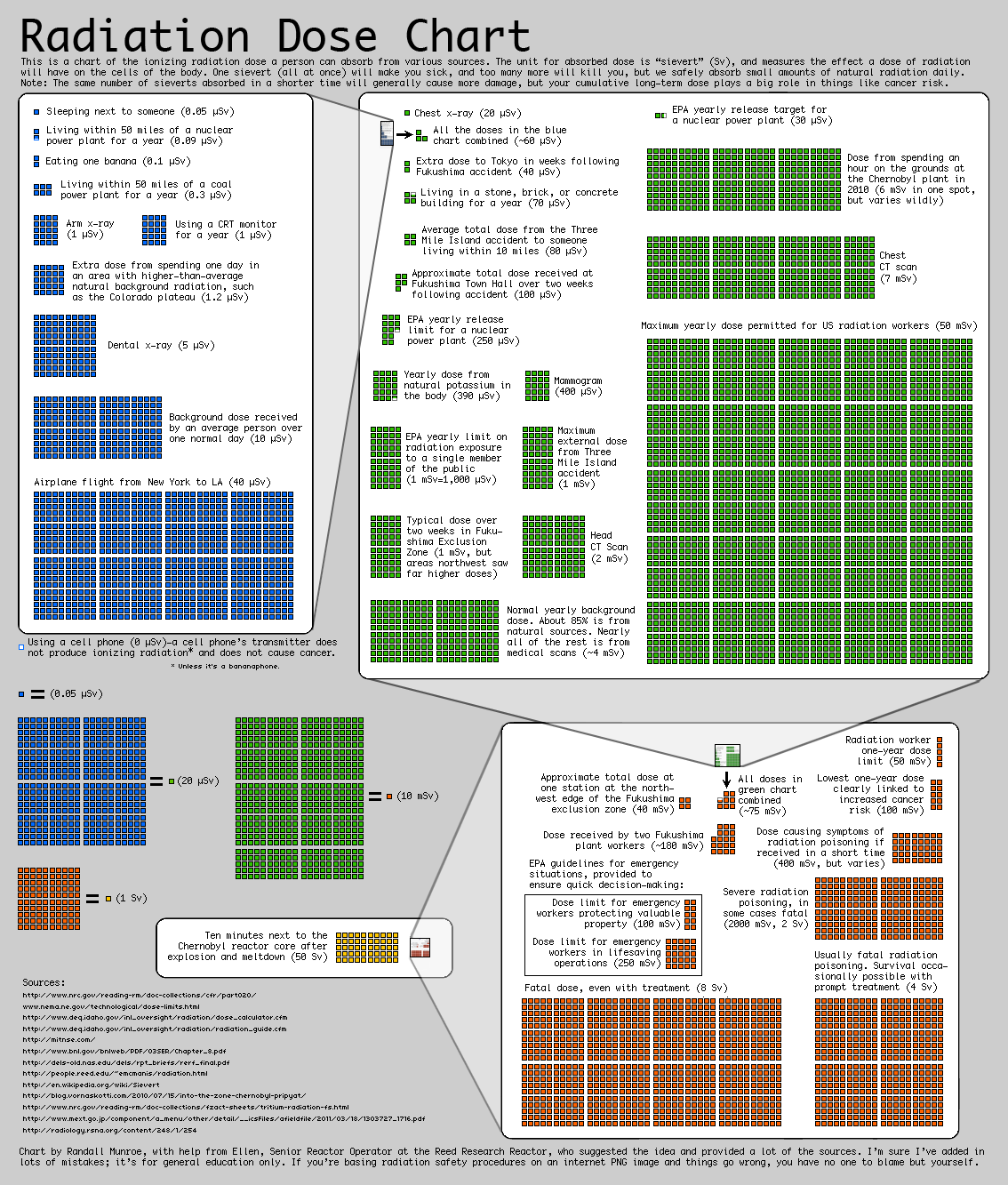
In summary, I'll be using the following units. CPS, measures how interesting something is. keV, works like a fingerprint for radioactive isotopes. And Sv and/or R, answer the question "How bad is it, Doc?"
My Samples
Background Radiation (~2026-02-23)

My first sample is... not a sample. There was a slight delay between when I got the geiger counter and when I got access to my first samples, so I spent three days gathering a spectrum from background radiation. This is actually useful for 2 reasons. First, it gives be something to compare future spectra against and makes the interesting peaks really stand out. And second, it makes sure my device is properly calibrated. You can see in the spectrum that there is a peak around 1461 keV. This means we're seeing more particles with this energy compared to the other energies around it. This is also one of the peaks associated with Potassium-40, the same radioactive isotope found in bananas. It turns out There's a lot of Potassium-40 in the background. Seeing this peak is how I know my device is calibrated. Also, yes, there are a lot of particles with lower engeries (< 300 keV). That's more just noise rather than an interesting peak. Of note, I did try to get a spectrum from some bananas, but I was unsuccessful. It's possible I didn't wait long enough or that the bananas just weren't active enough. Maybe I'll try again another time.
Two things to note about the information displayed. First, we can see that background radiation is around 6.5 CPS, primarily because I live in a concrete appartment. Second, the dosage is displayed in Roentgen. This is because the geiger counter is not biological matter, so it can't directly measure dosage for biological matter. Instead, R is the default unit and it estimates Sv as best as it can.
Antiquing! (2026-03-07)
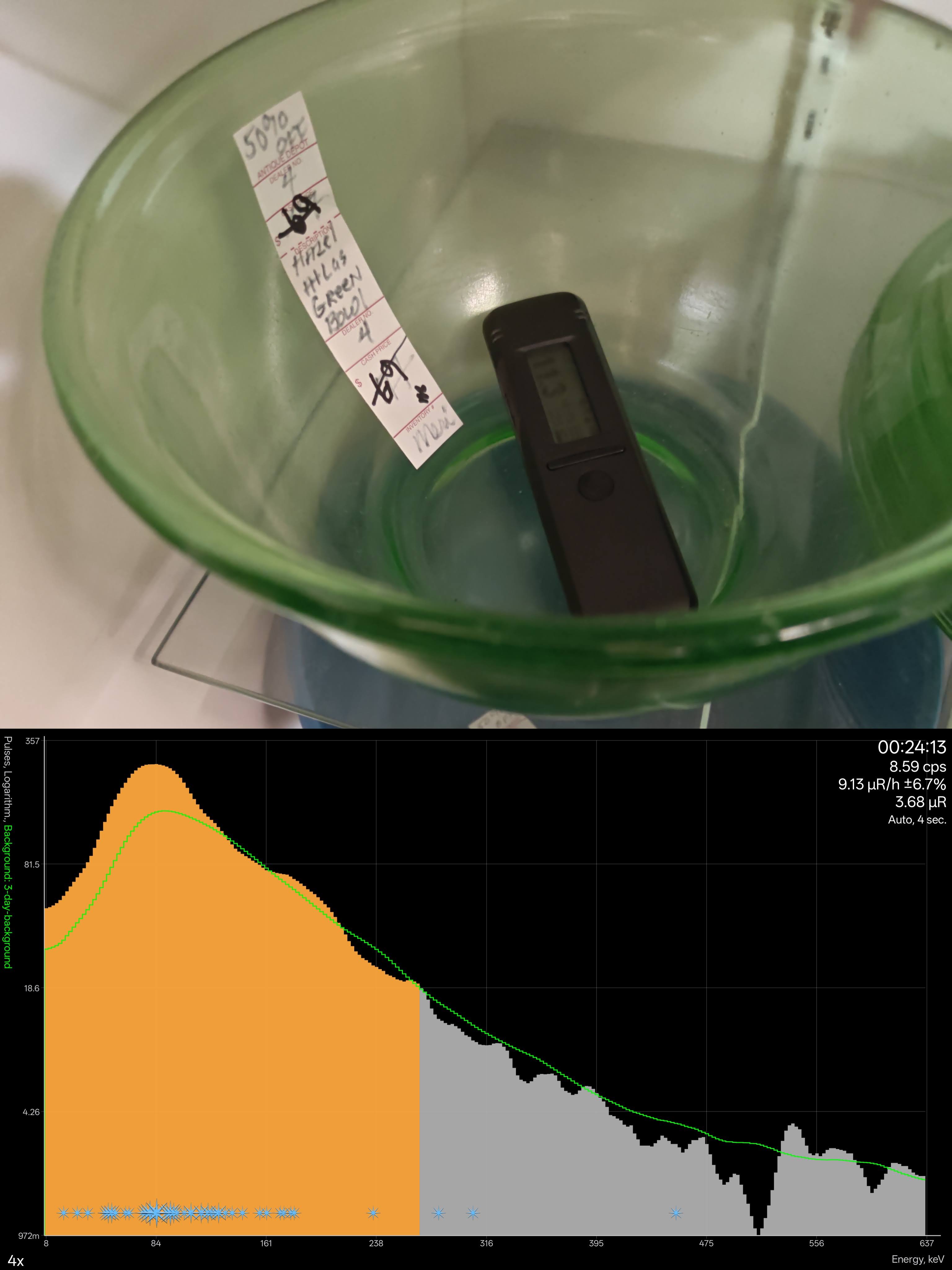
Sample 1: A few days after I got my new toy, my wife and I went to some antique stores to see what fun items we could find. For those who are unaware, antique stores are known to carry samples of Uranium glass and fiesta ware, which are up for sale. No, I wasn't allowed to buy any, sadly. A ew minutes into the first store and we already found some clearly labeled samples safely stored behind glass. So safely, in fact, that I couldn't pick them up on my geiger counter. No fun. However, just on the other side of the display was some unlabeled green glass, which brings me to my first sample.
Because this was my first shot, I did a terrible job collecting the spectrum and even the picture is blurry. However, you can see the beginnings of some interesting peaks, especially around 186 keV (One of the primary emissions for Uranium-235). In the picture, you can see the geiger counter clocking about 11 CPS, about 5-6 above background for that building. The most interesting part for me, and this would become a recurring theme, is that the glass is simply labeled as "Green Bowl." Nothing noting that it is Uranium. I find this interesting because not only is that a health concern, but vendors can mark up their glass if it is Uranium. This one was a little pricey anyways, so who knows.

Sample 2: A little more searching and we found some more clearly labeled Uranium glass. This one was even under black-light, highlighting the reason Uranium glass was so popular! There were plenty of samples in this display. The teacup shown here is a little more interesting than the previous glass at 13.7 CPS (I got readings as high as 16 CPS). I didn't get a spectrum from this glass as I had to hold the geiger counter in place and I was worried about bumping or breaking things. So we moved on in search of more glass.

Sample 3: This next piece was just sitting on a table out in the open and was labeled "Art Deco Plate Green, Black Optic" (It glows in the dark). Hmm, I wonder why that is... This plate was a great mix of only being $12, likely because the vendor didn't know it was Uranium, and being one of the hottest pieces I'd found yet.
Now is a good time to mention that Radiacode devices come with a companion app. That's where I'm doing all the spectrum analysis and where the screenshots come from. It does have a really cool feature that takes a picture and overlays the charts, but that functionality seems to be a little broken for me, as you will see with the next sample. I resorted to taking screenshots of the camera functionality whenever I could remember to. That's why the "take picture" button is on screen.
This sample is also the only good example of "Hardness" working. Basically, it boils all of the spectrum data down to a single number which correlates to specific radioactive isotopes. A lot of my other samples needed to have background subtracted in order to display the correct element (Uranium).
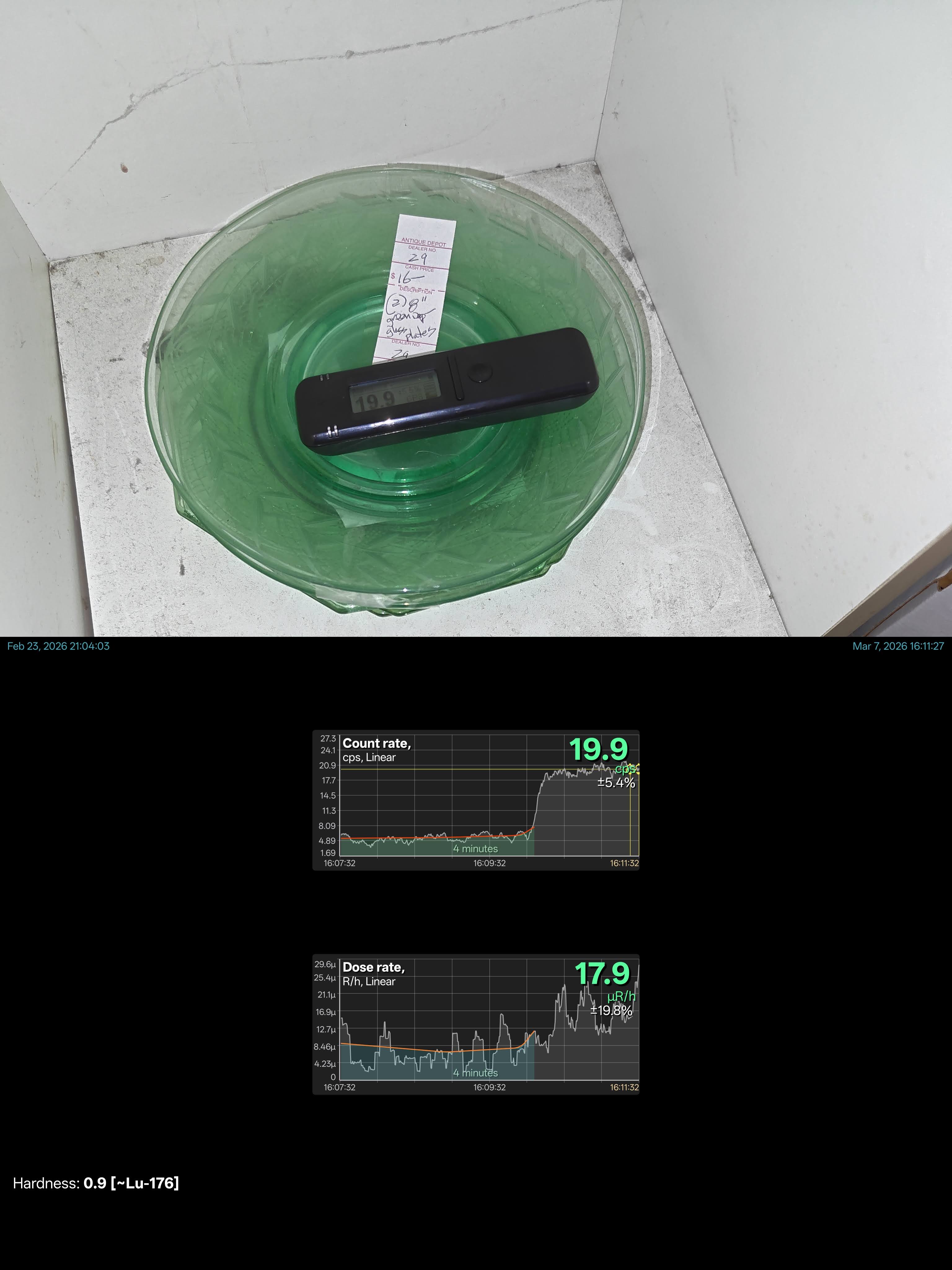
Sample 4: Now we're getting to the fun bits. Tucked away at the bottom of an otherwise empty shelf, labeled "Green deep glass plates," a mere $16, sat a stack of alpha emitters. Clocking in at 20 CPS and triggering the first of my geiger counter's alarms. If not for the samples that followed, this would have been the highlight of my day. I was ecstatic to find something strong enough to set of my geiger counter's alarms, partly because I wanted to know what it sounded like.
With the alarm going off and other people around, I worked a little too quickly and forgot to take a screenshot. So you can see how the charts were messed up. Either way, this was a great find. And of course the vendor had no idea the plates were Uranium. It pays to be curious. If I were allowed to buy any pieces, I would probably choose these. But alas, my wife and I couldn't find a safe, long-term storage solution, as there's probably a move in our near future. What a find!
A quick note on the alarms, I can set two alarms on my geiger counter. The first goes off at 20 CPS, and tells me something interesting is going on. The second one goes of at 60 and is a bit more serious. I had to get pretty close to measure the radiation on these plates since radiation dissipates folowing the square of the distance. If the second alarm were to go off just while I was walking around, something would be quite wrong. That's "drop everything and run" territory.
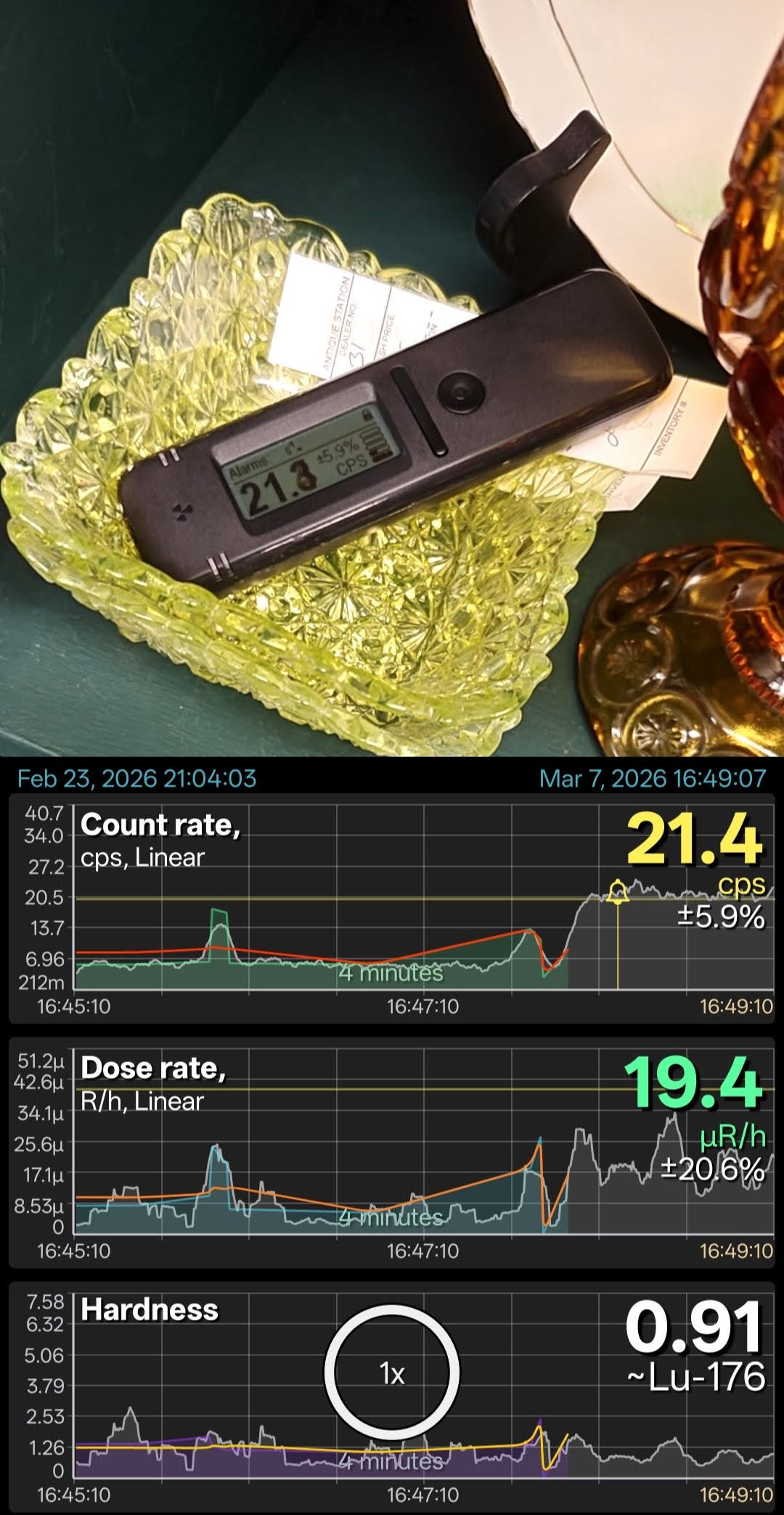

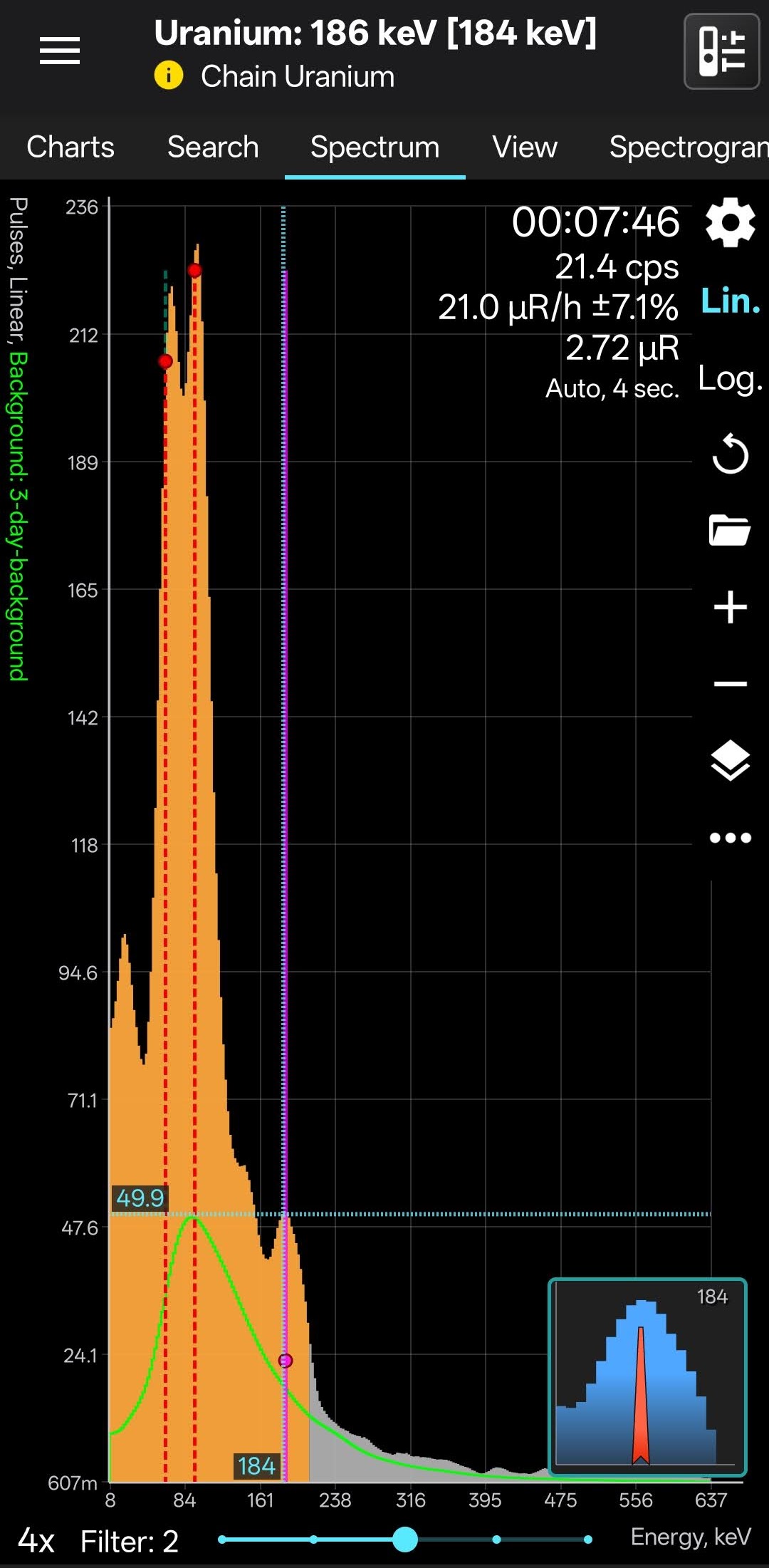
Sample 5: This, this is the peak of my day. It was about the only sample of glass I found in this particular shop, and boy was it hot. It immediately set off my first alarm and stayed above 20 CPS the whole time I monitored it (error can cause some variance). It was so good that this is what I decided to take a longer spectrum of. I gathered all 2 of my wits and turned off the alarm so I wouldn't startle people, then waited abouit 10 minutes. Even at 8 minutes you can see the spectrum was happy with the results (that's the orange portion). And now we can do some analysis.
The primary emission for Uranium-235 is at 186 keV, which we can clearly see. The app is also nice enough to highlight alternate peaks at 65 and 95 keV, which are the result of Thorium, one of the products of Uranium-235's decay chain. Based on this, we can positively identify the Uranium glass. Duh. I encourage you to compare this against the sample on radiacode's website, and observe that mine is pretty spot on. I could have waited a little longer to observe some of the less common emission lines, but it was late in the afternoon and I think this is good enough for now.
Lastly, these might seem like really hot samples, but my dosage for the day was still really low: less than 15 µSv. That's just a little more than my daily dosage from background radiation. And for the most part, I was much farther away from the samples than the geiger counter was, meaning my dosage was much smaller. Absolutely nothing to worry about.
Thanks for reading! I'll update here if I get any more interesting samples.
Image Citations
"Bohr atomic model of a nitrogen atom" Encyclopædia Britannica, Inc. https://www.britannica.com/science/Bohr-model (2026-03-11)
"Nuclear Reaction" By Kjerish - This image has been extracted from another file, CC BY-SA 4.0, https://commons.wikimedia.org/w/index.php?curid=54378478 (2026-03-11)