
Zonohedra and Zonotopes
A zonohedron is a polyhedron in which every face is centrally symmetric. Zonohedra can be defined in various ways, for instance as the Minkowski sums of line segments. The combinatorics of their faces are equivalent to those of line arrangements in the plane. (See my Mathematica Zonotope notebook for details of this equivalence as well as more examples of zonohedra.)
The equivalence of two face-centered icosahedral tilings with respect to local derivability, J. Phys. A26 (1993) 1455. J. Roth dissects an aperiodic three-dimensional tiling involving zonohedra into another tiling involving tetrahedra and vice versa.
How many intersection points can you form from an n-line arrangement? Equivalently, how many opposite pairs of faces can an n-zone zonohedron have? It must be a number between n-1 and n(n-1)/2, but not all of those values are possible.
Mark Newbold's Rhombic Dodecahedron Page.

Polyhedra Blender. Mathematica software and Java-based interactive web gallery for what look like Minkowski sums of polyhedra. If the inputs to the Minkowski sums were line segments, cubes, or zonohedra, the results would be again zonohedra, but the ability to supply other inputs allows more general polyhedra to be formed.
Rotating zonohedron. This truncated rhombic dodecahedron forms the logo of the T. U. Berlin Algorithmic and Discrete Math. Group.
Sylvester's theorem. This states that any finite non-colinear point set has a line containing only two points (equivalently, every zonohedron has a quadrilateral face). Michael Larsen, Tim Chow, and Noam Elkies discuss two proofs and a complex-number generalization. (They omit the very simple generalization from Euler's formula: every convex polyhedron has a face of degree at most five.)
Ukrainian Easter Egg. This zonohedron, computed by a Mathematica notebook I wrote, provides a lower bound for the complexity of the set of centroids of points with approximate weights.

Voronoi diagrams of lattices. Greg Kuperberg discusses an algorithm for constructing the Voronoi cells in a planar lattice of points. This problem is closely related to some important number theory: Euclid's algorithm for integer GCD's, continued fractions, and good approximations of real numbers by rationals. Higher-dimensional generalizations (in which the Voronoi cells form zonotopes) are much harder -- one can find a basis of short vectors using the well-known LLL algorithm, but this doesn't necessarily find the vectors corresponding to Voronoi adjacencies. (In fact, according to Senechal's Quasicrystals and Geometry, although the set of Voronoi adjacencies of any lattice generates the lattice, it's not known whether this set always contains a basis.)
What do you call a partially truncated rhombic dodecahedron? Doug Zare wants to know.
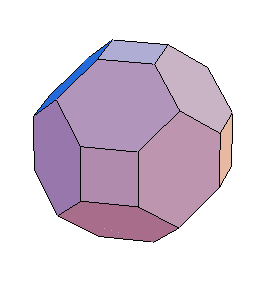
Zonohedra and cubic partial cubes. Connecting the geometric problem of classifying simplicial line arrangements to the graph-theoretic one of finding regular graphs that can be isometrically embedded on a cube.
Zonohedra and zonohedrification. From George Hart's virtual polyhedron collection.
Zonohedron. From Eric Weisstein's treasure trove of mathematics.
Zonohedron generated by 30 vectors in a circle, and another generated by 100 random vectors, Paul Heckbert, CMU. As a recent article in The Mathematica Journal explains, the first kind of shape converges to a solid of revolution of a sine curve. The second clearly converges to a sphere but Heckbert's example looks more like a space potato.
Zonotiles. Russell Towle investigates tilings of zonogons (centrally symmetric polygons) by smaller zonogons, and their relation to line arrangements, with an implementation in Mathematica.
Zonotopes. Helena Verrill wonders in how many ways one can decompose a polygon into parallelograms. The answer turns out to be equivalent to certain problems of counting pseudo-line arrangements.


