Miscellanous
Sometimes extremely miscellaneous...
Adventitious geometry. Quadrilaterals in which the sides and diagonals form more rational angles with each other than one might expect. Dave Rusin's known math pages include another article on the same problem.
Algorithmic mathematical art, Xah Lee.
Anton's modest little gallery of ray-traced 3d math.
On the average height of jute crops in the month of September. Vijay Raghavan points out an obscure reference to average case analysis of the Euclidean traveling salesman problem.
BitArt spirolateral gallery (requires JavaScript to view large images, and Java to view self-running demo or construct new spirolaterals).
Brahmagupta's formula. A "Heron-type" formula for the maximum area of a quadrilateral, Col. Sicherman's fave. He asks if it has higher-dimensional generalizations.
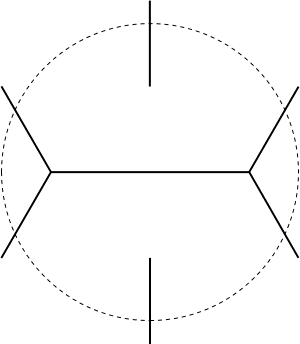
Building a better beam detector. This is a set that intersects all lines through the unit disk. The construction below achieves total length approximately 5.1547, but better bounds were previously known.
The Cheng-Pleijel point. Given a closed plane curve and a height H, this point is the apex of the minimum surface area cone of height H over the curve. Ben Cheng demonstrates this concept with the help of a Java applet.
Common misconception regarding a cube, Paul Bourke. No, the Egyptian pyramids were not formed by dropped giant cubes from space.
Complexification Gallery of Computation. Some kind of algorithmic art; I'm not sure what algorithms were used to produce it but the results are pretty.
Contour plots with trig functions. Eric Weeks discovers a method of making interesting non-moiré patterns.
Andrew Crompton. Grotesque geometry, Tessellations, Lifelike Tilings, Escher style drawings, Dissection Puzzles, Geometrical Graphics, Mathematical Art. Anamorphic Mirrors, Aperiodic tilings, Optical Machines.
Curvature of crossing convex curves. Oded Schramm considers two smooth convex planar curves crossing at at least three points, and claims that the minimum curvature of one is at most the maximum curvature of the other. Apparently this is related to conformal mapping. He asks for prior appearances of this problem in the literature.
DNA, apocalypse, & the end of the mystery. A sacred-geometry analysis of "the geometric pattern of the heavenly city which is the template of the New Jerusalem".
Sylvie Donmoyer geometry-inspired paintings including Menger sponges and a behind-the-scenes look at Escher's Stars.
Eight foxes. Daily geometry problems.
Electronic Geometry Models, a refereed archive of interesting geometric examples and visualizations.
Experiencing Geometry. A poem by David Henderson.
Fagnano's theorem. This involves differences of lengths in an ellipse. Joe Keane asks why it is unusual.
Famous curve applet index. Over fifty well-known plane curves, animated as Java applets.
Fourier series of a gastropod. L. Zucca uses Fourier analysis to square the circle and to make an odd spiral-like shape.
Fractal fiber bundles. Troy Christensen ponders origami on the fabric folds of spacetime.
Gallery of interactive on-line geometry. The Geometry Center's collection includes programs for generating Penrose tilings, making periodic drawings a la Escher in the Euclidean and hyperbolic planes, playing pinball in negatively curved spaces, viewing 3d objects, exploring the space of angle geometries, and visualizing Riemann surfaces.
Geek bodyart. Geometric calculations for fitting your piercings.
Geometric metaphors in literature, K. Kovaka.
Geometry of alphabets. Sacred geometry wackiness from the Library of Halexandria. Something about how the first verse of Genesis forms a dodecahedron, or a flower, or maybe a candlestick, somehow leading to squared circles, spiraling shofars, and circumscribed tetrahedra.
Geometry problems involving circles and triangles, with proofs. Antonio Gutierrez.
Gömböc, a convex body in 3d with a single stable and a single unstable point of equilibrium. Placed on a flat surface, it always rights itself; it may not be a coincidence that some tortoise shells are similarly shaped. See also Gömböc on Wikipedia, Gömböc on Metafilter, and Gömböc in The New York Times.
Greg's favorite math party trick. A nice visual proof of van Aubel's theorem, that equal perpendicular line segments connect the opposite centers of squares exterior to the sides of any quadrilateral. See also van Aubel's theorem on Wikipedia, van Aubel's theorem on MathWorld, van Aubel's theorem in the land of the Incas, and an interactive Java van Aubel's theorem applet.
Ham Sandwich Theorem: you can always cut your ham and two slices of bread each in half with one slice, even before putting them together into a sandwich. From Eric Weisstein's treasure trove of mathematics.
Jean-Pierre Hébert - Studio. Algorithmic and geometric art site.
Helical geometry. Ok, renaming a hyperbolic paraboloid a "helical right triangle" and saying that it's "a revolutionary foundation for new knowledge" seems a little cranky but there are some interesting pictures of shapes formed by compounds of these saddles.
How to write "computational geometry" in Japanese (or Chinese).
Human Geometry and Naked Geometry. The human form as a building block of larger geometric figures, by Mike Naylor.
Images of geometry. From the geometry center graphics archives. More images, from "Interactive Methods for Visualizable Geometry", A. Hanson, T. Munzner, and G. Francis.
Imagine, Geometry. Starting with visions of pre-natal consciousness in 1968. Primary-colored animations of platonic solids turn your brain cells into puffed, expanded dodecahedra.
Japanese Temple Geometry, Gordon Coale. See also this clickable temple geometry tablet map. Unfortunately Scientific American seems to have taken down their (May 1998) article on the subject.
Java lamp, S. M. Christensen.
Jordan sorting. This is the problem of sorting (by x-coordinate) the intersections of a line with a simple polygon. Complicated linear time algorithms for this are known (for instance one can triangulate the polygon then walk from triangle to triangle); Paul Callahan discusses an alternate algorithm based on the dynamic optimality conjecture for splay trees.
The Kakeya-Besicovitch problem. Paul Wellin describes this famous problem of rotating a needle in a planar set of minimal area. As it turns out the area can be made arbitrarily close to zero. See also Steven Finch's page on Kakeya-Besicovitch constants, and Eric Weisstein's page on the Kakeya Needle Problem.
King of Infinite Space. A new biography of H. S. M. Coxeter by Siobhan Roberts.
Kurschak's tile and Kurschak's theorem about the area of a circle-inscribed dodecagon.
The Landscape of Geometry Terms. Musical and typographic presentation of geometric nomenclature.
Language Generator Tool and Die Lab. Tennis ball theorems, hourglass theorems, and cellular hierarchies. From a truly self-programmed individual.
Leaper tours. Can generalized knights jump around generalized chessboards visiting each square once? By Ed Pegg Jr.
Lego sextic. Clive Tooth draws infinity symbols using lego linkages, and analyzes the resulting algebraic variety.
Line designs for the computer. Jill Britton brings to the web material from John Millington's 1989 book on geometric patterns formed by stitching yarn through cardboard. The Java simulation of a Spectrum computer running Basic programs is a little (ok a lot) clunky, and froze Mozilla when I tried it, but there's also plenty of interesting static content.
Jim Loy's geometry pages. With special emphases on geometric constructions (and non-constructions such as trisection of an angle) as well as many nice Cinderella animations.
Marius Fine Art Studio Sacred Geometry Art. Prints and paintings for sale of various geometric designs.
Meru Foundation appears to be another sacred geometry site, with animated gifs of torus knots and other geometric visualizations and articles.
Mirrored room illumination. A summary by Christine Piatko of the old open problem of, given a polygon in which all sides are perfect mirrors, and a point source of light, whether the entire polygon will be lit up. The answer is no if smooth curves are allowed. See also Eric Weisstein's page on the Illumination Problem.
Movies by Impulse. Computational geometry applied to the simulation of bowling allies and poolhalls.
Mike Naylor's ASCII art. Platonic solids, knots, fractals, and more.
A new Masonic interpretation of Euclid's 47th Problem. Confused about why those wacky Freemasons care so much about the Pythagorean Theorem, Bro. Jeff Peace proposes the existence of a different Euclid and a different 47th problem more related to theology than geometry.
New perspective systems, by Dick Termes, an artist who paints inside-out scenes on spheres which give the illusion of looking into separate small worlds. His site also includes an unfolded dodecahedron example you can print, cut, and fold yourself.
Number patterns, curves, and topology, J. Britton. Includes sections on the golden ratio, conics, Moiré patterns, Reuleaux triangles, spirograph curves, fractals, and flexagons.
Objects that cannot be taken apart with two hands. J. Snoeyink, U. British Columbia.
Person polygons. Marc van Kreveld defines this interesting and important class of simple polygons, and derives a linear time algorithm (with a rather large constant factor) for recognizing a special case in which there are many reflex vertices.
The Perspective Page. A short introduction to the geometry of perspective drawing.
Phaistos disk geometry. Claire Watson examines the patterns on a Mediterranean bronze-age artifact.
Place kicking locus in rugby, Michael de Villiers. See also Villiers' other geometry papers.
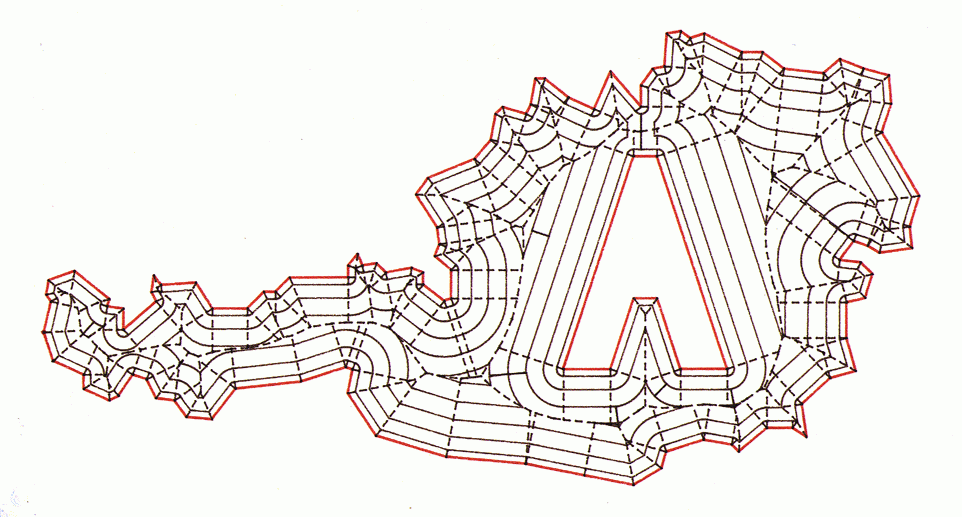
Plan for pocket-machining Austria, M. Held, Salzburg.
Plücker coordinates. A description by Bob Knighten of this useful and standard way of giving coordinates to lines, planes, and higher dimensional subspaces of projective space.
Postscript geometry. Bill Casselman uses postscript to motivate a course in Euclidean geometry. See also his Coxeter group graph paper, and Ed Rosten's postscript doodles. Beware, however, that postscript can not really represent such basic geometric primitives as circles, instead approximating them by splines.
Programming for 3d modeling, T. Longtin. Tensegrity structures, twisted torus space frames, Moebius band gear assemblies, jigsaw puzzle polyhedra, Hilbert fractal helices, herds of turtles, and more.
Puzzles. Discussions on the geometry.puzzles list, collected by topic at the Swarthmore Geometry Forum.
Quadrorhomb rotary engine with chambers defined by the bars of a twelve-bar linkage rotating around two nonconcentric axes.
Random polygons. Tim Lambert summarizes responses to a request for a good random distribution on the n-vertex simple polygons.
Ray-trace rendering. Richard M. Smith uses POVray to view complex geometric scenes.
Reconstruction of a closed curve from its elliptic Fourier descriptor. The ancient epicycle theory of planetary motion, animated in Java.
Ruler and Compass. Mathematical web site including special sections on the geometry of polyhedrons and geometry of polytopes.
Sacred Geometry. Mystic insights into the "principle of oneness underlying all geometry", mixed with occasional outright falsehoods such as the suggestion that dodecahedra and icosahedra arise in crystals. But the illustrative diagrams are ok, if you just ignore the words... For more mystic diagrams, see The Sacred Geometry Coloring Book.
Sacred geometry, new discoveries linking the great pyramid to the human form. Charles Henry finds faces in raytraces of reflecting spheres.
Sangaku problem. The incenters of four triangles in a cyclic quadrilateral form a rectangle. Animated in Shockwave by Antonio Gutierrez.
Secrets of Da Vinci's challenge. A discussion of the symbology and design of this interlocked-circle-pattern puzzle.
Sedona Sacred Geometry Conference, Feb. 2004.
Self-righting shapes. Figures with only one stable and one unstable equilibrium, when placed on a level surface. Surprisingly, they look much like certain kinds of turtles. Julie J. Rehmeyer in MathTrek.
Sensitivity analysis for traveling salesmen, C. Jones, U. Washington. Still a good title, and now the geometry has been made more entertaining with Java and VRML.
Shape metrics. Larry Boxer and David Fry provide many bibliographic references on functions measuring how similar two geometric shapes are.
Sighting point. John McKay asks, given a set of co-planar points, how to find a point to view them all from in a way that maximizes the minimum viewing angle between any two points. Somehow this is related to monodromy groups. I don't know whether he ever got a useful response. This is clearly polynomial time: the decision problem can be solved by finding the intersection of O(n2) shapes, each the union of two disks, so doing this naively and applying parametric search gives O(n4 polylog), but it might be interesting to push the time bound further. A closely related problem of smoothing a triangular mesh by moving points one at a time to optimize the angles of incident triangles can be solved in linear time by LP-type algorithms [Matousek, Sharir, and Welzl, SCG 1992; Amenta, Bern, and Eppstein, SODA 1997].
Smarandache Manifolds online e-book by Howard Iseri. I'm not sure I see why this should be useful or interesting, but the idea seems to be to define geometry-like structures (having objects called points and lines that somehow resemble Euclidean points and lines) that are non-uniform in some strong sense: every Euclidean axiom (and why not, every Euclidean theorem?) should be true at some point of the geometry and false at some other point.
Smoothly rolling polygonal wheels and their roads, H. Serras, Ghent.
Squares on a Jordan curve. Various people discuss the open problem of whether any Jordan curve in the plane contains four points forming the vertices of a square, and the related but not open problem of how to place a square table level on a hilltop. This is also in the geometry.puzzles archive.
Splitting the hair. Matthew Merzbacher discusses how many times one can subdivide a line segment by following certain rules.
Subdivision kaleidoscope. Strange diatom-like shapes formed by varying the parameters of a spline surface mesh refinement scheme outside their normal ranges.
Supershapes and 3d supershapes. Paul Bourke generates a wide variety of interesting shapes from a simple formula. See also John Whitfield's Nature article.
Synergetic geometry, Richard Hawkins' digital archive. Animations and 3d models of polyhedra and tensegrity structures. Very bandwidth-intensive.
Tensegrity zoology. A catalog of stable structures formed out of springs, somehow forming a quantum theory of what used to be described as time.
Three classical geek problems solved! Hauke Reddmann, Hamburg.
Tic tac toe theorem. Bill Taylor describes a construction of a warped tic tac toe board from a given convex quadrilateral, and asks for a proof that the middle quadrilateral has area 1/9 the original. Apparently this is not even worth a chocolate fish.
Triply orthogonal surfaces, Matthias Weber.
Typeface Venus, Circle Marilyn, and Bubble Mona. village9991 uses quadtrees and superellipses to make abstract mosaics of famous faces.
Unreal project. Non-photorealistic rendering of mathematical objects, Amenta, Duvall, and Rowley. Here's another unreal page.
Visual Mathematics, journal and exhibitions relating art and math.
The Vitruvian Man. Connections between Leonardo's polygon-inscribed human figure and sacred temple geometry.
What can we measure? A gentle introduction to geometric measure theory.
Zef Damen Crop Circle Reconstructions. What is the geometry underlying the construction of these large-scale patterns?