Knot Theory
There is of course an enormous body of work on knot invariants, the 3-manifold topology of knot complements, connections between knot theory and statistical mechanics, etc. I am instead interested here primarily in geometric questions arising from knot embeddings.
Atlas of oriented knots and links, Corinne Cerf extends previous lists of all small knots and links, to allow each component of the link to be marked by an orientation.
Borromean rings don't exist. Geoff Mess relates a proof that the Borromean ring configuration (in which three loops are tangled together but no pair is linked) can not be formed out of circles. Dan Asimov discusses some related higher dimensional questions. Matthew Cook conjectures the converse.
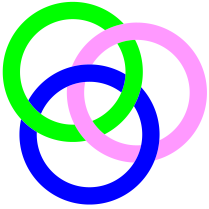
Are Borromean links so rare? S. Javan relates the history of the links and describes various generalizations with more than three rings. For more history and symbolism of the Borromean rings, see Peter Cromwell's web site.
A Brunnian link. Cutting any one of five links allows the remaining four to be disconnected from each other, so this is in some sense a generalization of the Borromean rings. However since each pair of links crosses four times, it can't be drawn with circles.
Collinear points on knots. Greg Kuperberg shows that a non-trivial knot or link in R3 necessarily has four colinear points.
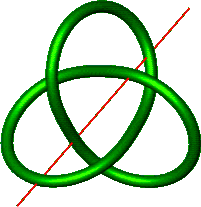
Crocheted Seifert surfaces by Matthew Wright. George Hart, Make Magazine.
Curvature of knots. Steve Fenner proves the Fary-Milnor theorem that any smooth, simple, closed curve in 3-space must have total curvature at least 4 pi.
Cut-the-knot logo. With a proof of the origami-folklore that this folded-flat overhand knot forms a regular pentagon.
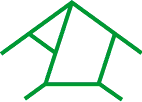
Detecting the unknot in polynomial time, C. Delman and K. Wolcott, Eastern Illinois U.
Figure eight knot / horoball diagram. Research of A. Edmonds into the symmetries of knots, relating them to something that looks like a packing of spheres. The MSRI Computing Group uses another horoball diagram as their logo.
Fractal knots, Robert Fathauer.
Geometric Arts. Knots, fractals, tesselations, and op art. Formerly Quincy Kim's World of Geometry.
Geometry and the Imagination in Minneapolis. Notes from a workshop led by Conway, Doyle, Gilman, and Thurston. Includes several sections on polyhedra, knots, and symmetry groups.
Hyperbolic Knot. From Eric Weisstein's treasure trove of mathematics.
Aaron Kellner Linear Sculpture. Art in the form of geometric tangles of metal and wood rods.
Knot art. Keith and Fran Griffin.
Knot pictures. Energy-minimized smooth and polygonal knots, from the ming knot evolver, Y. Wu, U. Iowa.
KnotPlot. Pictures of knots and links, from Robert Scharein at UBC.
Knots on the Web, P. Suber. Includes sections on knot tying and knot art as well as knot theory.
Mathematical imagery by Jos Leys. Knots, Escher tilings, spirals, fractals, circle inversions, hyperbolic tilings, Penrose tilings, and more.
Louis Bel's povray galleries: les polyhèdres réguliers, knots, and more knots.
Maille Weaves. Different repetitive patterns formed by linked circles along a plane in space, as used for making chain mail. Along with some linear patterns for jewelry chains.
Mathematically correct breakfast. George Hart describes how to cut a single bagel into two linked Möbius strips. As a bonus, you get more surface area for your cream cheese than a standard sliced bagel.
Mathematics in John Robinson's symbolic sculptures. Borromean rings, torus knots, fiber bundles, and unorientable geometries.
Meru Foundation appears to be another sacred geometry site, with animated gifs of torus knots and other geometric visualizations and articles.
Modularity in art. Slavik Jablan explores connections between art, tiling, knotwork, and other mathematical topics.
Mutations and knots. Connections between knot theory and dissection of hyperbolic polyhedra.
Orthogonal discrete knots. Hew Wolff asks questions about the minimum total length, or the minimum volume of a rectangular box, needed to form different knots as three-dimensional polygons using only integer-length axis-parallel edges.
Penrose mandala and five-way Borromean rings.
The Pretzel Page. Eric Sedgwick uses animated movies of twisting pretzel knots to visualize a theorem about Heegard splittings (ways of dividing a complex topological space into two simple pieces).
Programming for 3d modeling, T. Longtin. Tensegrity structures, twisted torus space frames, Moebius band gear assemblies, jigsaw puzzle polyhedra, Hilbert fractal helices, herds of turtles, and more.
In search of the ideal knot. Piotr Pieranski applies an iterative shrinking heuristic to find the minimum length unit-diameter rope that can be used to tie a given knot.
SnapPea, powerful software for computing geometric properties of knot complements and other 3-manifolds.
Soap films on knots. Ken Brakke, Susquehanna.
Space Cubes plastic geometric modeling puzzle based on a rectangular Borromean link.
Square Knots. This article by Brian Hayes for American Scientist examines how likely it is that a random lattice polygon is knotted.
Morwen Thistlethwait, sphere packing, computational topology, symmetric knots, and giant ray-traced floating letters.
Trefoil knot stairs. Java animation of an Escher-like infinite stair construction, intended as a Montreal metro station sculpture, by Guillaume LaBelle.
Triangulating 3-dimensional polygons. This is always possible (with exponentially many Steiner points) if the polygon is unknotted, but NP-complete if no Steiner points are allowed. The proof uses gadgets in which quadrilaterals are stacked like Pringles to form wires.