Width, Diameter, and Geometric Inequalities
Antipodes. Jim Propp asks whether the two farthest apart points, as measured by surface distance, on a symmetric convex body must be opposite each other on the body. Apparently this is open even for rectangular boxes.
Centers of maximum matchings. Andy Fingerhut asks, given a maximum (not minimum) matching of six points in the Euclidean plane, whether there is a center point close to all matched edges (within distance a constant times the length of the edge). If so, it could be extended to more points via Helly's theorem. Apparently this is related to communication network design. I include a response I sent with a proof (of a constant worse than the one he wanted, but generalizing as well to bipartite matching).
A Counterexample to Borsuk's Conjecture, J. Kahn and G. Kalai, Bull. AMS 29 (1993). Partitioning certain high-dimensional polytopes into pieces with smaller diameter requires a number of pieces exponential in the dimension.
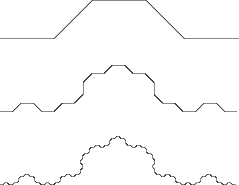
A fractal beta-skeleton with high dilation. Beta-skeletons are graphs used, among other applications, in predicting which pairs of cities should be connected by roads in a road network. But if you build your road network this way, it may take you a long time to get from point a to point b.
Graham's hexagon, maximizing the ratio of area to diameter. You'd expect it to be a regular hexagon, right? Wrong. From MathSoft's favorite constants pages. See also Graham's Biggest Little Hexagon from MathWorld, and Wolfgang Schildbach's java animation of this hexagon and similar n-gons for larger values of n.
The isoperimetric problem for pinwheel tilings. In these aperiodic tilings (generated by a substitution system involving similar triangles) vertices are connected by paths almost as good as the Euclidean straight-line distance.
The Kakeya-Besicovitch problem. Paul Wellin describes this famous problem of rotating a needle in a planar set of minimal area. As it turns out the area can be made arbitrarily close to zero. See also Steven Finch's page on Kakeya-Besicovitch constants, and Eric Weisstein's page on the Kakeya Needle Problem.
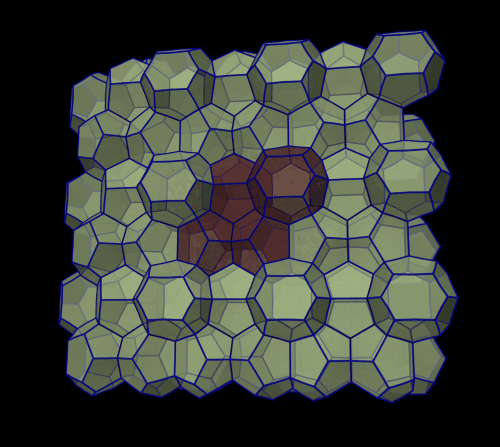
Kelvin conjecture counterexample. Evelyn Sander forwards news about the discovery by Phelan and Weaire of a better way to partition space into equal-volume low-surface-area cells. Kelvin had conjectured that the truncated octahedron provided the optimal solution, but this turned out not to be true. See also Ruggero Gabbrielli's comparison of equal-volume partitions and JavaView foam models.
The Margulis Napkin Problem. Jim Propp asked for a proof that the perimeter of a flat origami figure must be at most that of the original starting square. Gregory Sorkin provides a simple example showing that on the contrary, the perimeter can be arbitrarily large.
Minimax elastic bending energy of sphere eversions. Rob Kusner, U. Mass. Amherst.
Moser's Worm. What is the smallest area shape (in a given class of shapes) that can cover any unit-length path? Part of Mathsoft's collection of mathematical constants.
Not. AMS Cover, Apr. 1995. This illustration for an article on geometric tomography depicts objects (a cuboctahedron and warped rhombic dodecahedron) that disguise themselves as regular tetrahedra by having the same width function or x-ray image.
A quasi-polynomial bound for the diameter of graphs of polyhedra, G. Kalai and D. Kleitman, Bull. AMS 26 (1992). A famous open conjecture in polyhedral combinatorics (with applications to e.g. the simplex method in linear programming) states that any two vertices of an n-face polytope are linked by a chain of O(n) edges. This paper gives the weaker bound O(nlog d).
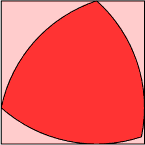
Reuleaux triangles. These curves of constant width, formed by combining three circular arcs into an equilateral triangle, can drill out (most of) a square hole.
Sofa movers' problem. This well-known problem asks for the largest area of a two-dimensional region that can be moved through a hallway with a right-angled bend. Part of Mathsoft's collection of mathematical constants.
The tea bag problem. How big a volume can you enclose by two square sheets of paper joined at the edges? See also the cubical teabag problem.
Uniqueness of focal points. A focal point (aka equichord) in a star-shaped curve is a point such that all chords through the point have the same length. Noam Elkies asks whether it is possible to have more than one focal point, and Curtis McMullen discusses a generalization to non-star-shaped curves. This problem has recently been put to rest by Marek Rychlik.
Universal coverage constants. What is the minimum area figure of a given type that covers all unit-diameter sets? Part of Mathsoft's collection of mathematical constants.
Volume of a torus. Paul Kunkel describes a simple and intuitive way of finding the formula for a torus's volume by relating it to a cylinder.
Worm in a box. Emo Welzl proves that every curve of length pi can be contained in a unit area rectangle.