Practice Problem Set 4 Solutions
Find the suffix array for the word sassafras (Include the end-of-string character, as in the lecture slides. Just list the positions of each suffix in the array; do not include the precomputed LCP information for fast searching. You do not have to go through the steps of the linear-time construction algorithm.)
Solution: The suffixes and their starting positions are
0 : sassafras$1 : assafras$2 : ssafras$3 : safras$4 : afras$5 : fras$6 : ras$7 : as$8 : s$9 : $
In alphabetically sorted order, with
$before any letter, they are:9 : $4 : afras$7 : as$1 : assafras$5 : fras$6 : ras$, 8 : s$3 : safras$0 : sassafras$2 : ssafras$
So the suffix array is
[9,4,7,1,5,6,8,3,0,2].Find a string \(s\) of six symbols from the two-symbol alphabet \(\{0,1\}\) (plus a seventh end-of-string character $) such that the suffix tree of \(s\) has only ten nodes in it. (Hints: for the suffix tree to be this small, every non-leaf node must have exactly three children. And for a non-leaf node to have a child starting with the symbol $, the substring that it represents must be a suffix of \(s\).)
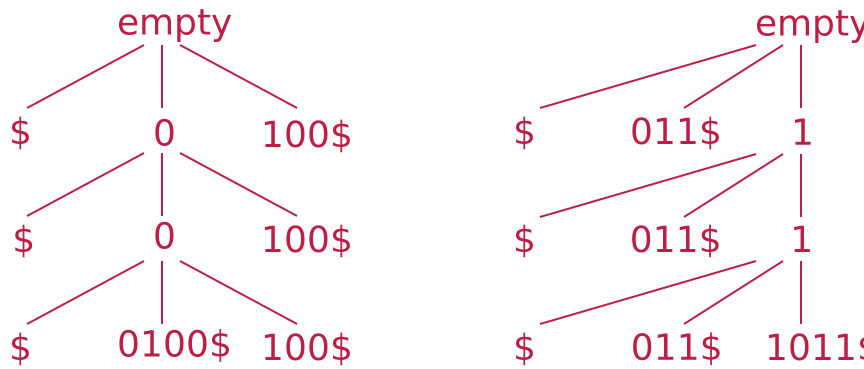
Solution: Either
000100$or111011$works. The two resulting suffix trees are shown below.