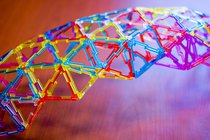
This page describes physical objects
corresponding to geometric constructions (and methods for creating such
objects), particularly
polytopes.
See also the origami page, for models made of
folded paper, and the toys page, for some
commercially-available geometric model construction kits.
The downstairs half bath.
Bob Jenkins decorated his bathroom with ceramic and painted pentagonal tiles.
Escher for real and
beyond
Escher for real.
Gershon Elber uses layered manufacturing systems to build 3d models of
Escher's illusions. The trick is to make some seemingly-flat surfaces
curve towards and away from the viewplane.
Fisher Pavers.
A convex heptagon and some squares produce an interesting four-way
symmetric tiling system.
Flat
equilateral tori. Can one build a polyhedral torus in which all
faces are equilateral triangles and all vertices have six incident
edges? Probably not but this physical model comes close.
Fun with Fractals and
the Platonic Solids. Gayla Chandler places models of polyhedra and
polyhedral fractals such as the Sierpinski tetrahedron in scenic outdoor
settings and photographs them there.
Melinda
Green's geometry page. Green makes models of regular sponges
(infinite non-convex generalizations of Platonic solids) out of plastic
"Polydron" pieces.
Hyperbolic crochet coral
reef, the Institute for Figuring.
Daina Taimina's technique for crocheting yarn into hyperbolic surfaces
forms the basis for an exhibit of woolen undersea fauna and flora.
Hyperbolic
shortbread. The Davis math department eats a Poincaré model
of a tiling of the hyperbolic plane by 0-60-90 triangles.
The
hyperbolic surface activity page. Tom Holroyd describes hyperbolic
surfaces occurring in nature, and explains how to make a paper model of
a hyperbolic surface based on a tiling by heptagons.
Mathematically
correct breakfast. George Hart describes how to cut a single bagel
into two linked Möbius strips. As a bonus, you get more surface
area for your cream cheese than a standard sliced bagel.
Models
of Mathematical Machines at the University Museum of Natural Science
and Scientific Instruments of the University of Modena.
Main exhibit is in Italian but there is an English
preface
and
htm.
The Sierpinski Tetrahedron, everyone's
favorite three dimensional fractal.
Alexander Graham Bell made kites in this shape,
and it has been a frequent construction of geometric model-makers ever since.
Sliceforms,
3d models made by interleaving two directions of planar slices.
Solid object which generates an anomalous picture.
Kokichi Sugihara makes models of Escher-like illusions from folded paper.
He has plenty more where this one came from, but maybe the others
aren't on the web.
Solving
the Petersen Graph Zome Challenge.
David MacMahon discovers that there is no way to make a
non-self-intersecting peterson graph with Zome tool.
Includes VRML illustrations.
Federation Square.
This building in Melbourne uses the pinwheel
tiling as a design motif. Thanks to Khalad Karim for identifying it.
Photos by Dick Hess, scanned by Ed Pegg Jr.
See this Flickr
photopool for many more photos.
Voronoi Art.
Scott Sona Snibbe uses a retro-reflective floor to display the Voronoi
diagram of people walking on it, exploring notions of personal space and
individual-group relations.
Additional Voronoi-based art is included in his
dynamic
systems series.
The
Water Cube swimming venue at the 2008 Beijing Olympics uses the
Weaire-Phelan foam (a partition of 3d space into equal-volume cells with
the minimum known surface area per unit volume) as the basis of its structure.
Zonohedron
Beta. A flexible polyhedron model made by Bathsheba
Grossman out of aluminum, stainless steel, and brass
(bronze optional). Also see the rest of Grossman's
geometric sculpture.